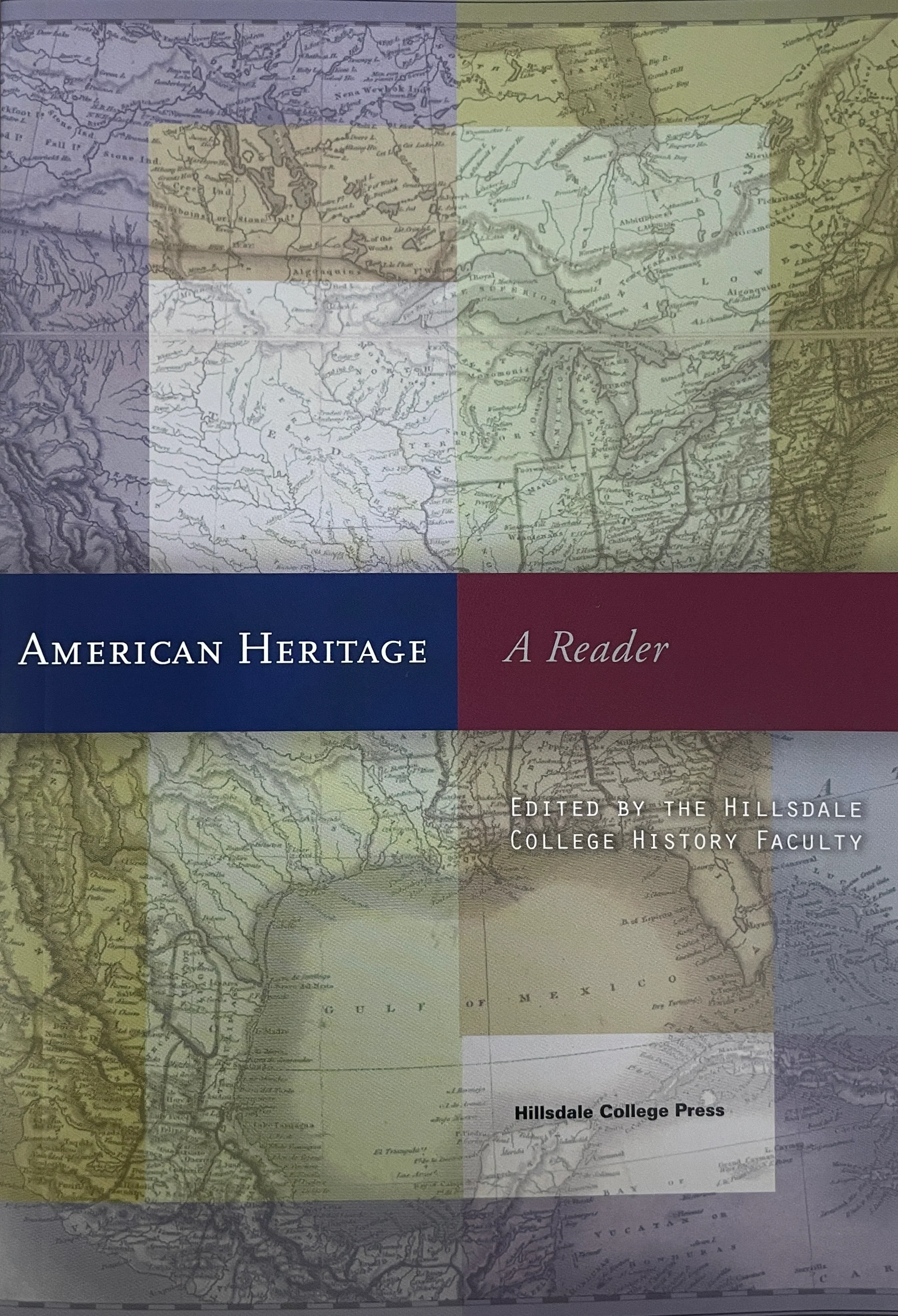
American Heritage: A Hillsdale College Reader
From the Preface:
Nevertheless, as we have noted, there remains an intensely practical application of studying the American Heritage. If liberal education is to survive, if its priceless effort of turning hearts and minds toward the good and the true is to continue, then self-governed citizens must maintain the cultural conditions that foster liberal education. America is a land of liberty where liberal education has long prospered. Without such liberty, the very enterprise of liberal education in America may be imperiled. The starting place for any maintenance of American liberty is the study of the American Heritage, a necessary and practical duty for any self-governed member of a free society. Finally, there is nothing more practical than understanding the world in which one lives and knowing how to distinguish that which is timeless from the passing fads and fashions of the day. Perhaps C.S. Lewis expressed this notion best in his splendid essay "Learning in War-Time":
"We need intimate knowledge of the past. Not that the past has any magic about it, but because we...need something to set against the present, to remind us that the basic assumptions have been quite different in different periods and that much which seems certain to the uneducated is merely temporary fashion. A man who has lived in many places is not likely to be deceived by the local errors of his native village; the scholar has lived in many times and is therefore in some degree immune from the greatest cataract of nonsense that pours from the press and microphone of his own age."
The study of history enables one to escape from the narrowness of "chronological snobbery" or "presentism," the culturally crippling condition of those who ignore wise voices from the past. Such folk trust, instead, only the ignorant set of fools described by G.K. Chesterton as the "arrogant oligarchy of those who merely happen to be walking about." Students of our heritage can escape that lot.
Just as the American Heritage unfolded over time and was the product of many minds, this book issued from the collective efforts of more than a dozen colleagues from the Hillsdale history faculty working and teaching together for over a decade. Some who worked on this volume at its inception have moved on. John Wilson, who has retired from full-time teaching, and Ted McAllister, now at Pepperdine University in California, played important roles, John as the senior member of the department in the early days of this project and Ted as an early contributor to the effort. Others, new faculty when we began, have matured into tenured and seasoned professors while teaching these documents. Although the documents in this volume were written by others, the process of their selection and editing was our own labor. Further, each document opens with an introduction written by a member of our history faculty, as does each chapter of the book. Recognition for such effort is owed to Thomas Conner, Lucy Moye, Paul Moreno, Paul Rahe, Harold Siegel, Burt Folsom, Richard Gamble, David Raney, and especially to Bradley Birzer and David Stewart whose tireless enthusiasm and remarkable organizational talents were conspicuous and invaluable.
MARK A. KALTHOFF
Chairman
Department of History
HILLSDALE COLLEGE
Hillsdale, Michigan
Original: $30.00
-70%$30.00
$9.00American Heritage: A Hillsdale College Reader
From the Preface:
Nevertheless, as we have noted, there remains an intensely practical application of studying the American Heritage. If liberal education is to survive, if its priceless effort of turning hearts and minds toward the good and the true is to continue, then self-governed citizens must maintain the cultural conditions that foster liberal education. America is a land of liberty where liberal education has long prospered. Without such liberty, the very enterprise of liberal education in America may be imperiled. The starting place for any maintenance of American liberty is the study of the American Heritage, a necessary and practical duty for any self-governed member of a free society. Finally, there is nothing more practical than understanding the world in which one lives and knowing how to distinguish that which is timeless from the passing fads and fashions of the day. Perhaps C.S. Lewis expressed this notion best in his splendid essay "Learning in War-Time":
"We need intimate knowledge of the past. Not that the past has any magic about it, but because we...need something to set against the present, to remind us that the basic assumptions have been quite different in different periods and that much which seems certain to the uneducated is merely temporary fashion. A man who has lived in many places is not likely to be deceived by the local errors of his native village; the scholar has lived in many times and is therefore in some degree immune from the greatest cataract of nonsense that pours from the press and microphone of his own age."
The study of history enables one to escape from the narrowness of "chronological snobbery" or "presentism," the culturally crippling condition of those who ignore wise voices from the past. Such folk trust, instead, only the ignorant set of fools described by G.K. Chesterton as the "arrogant oligarchy of those who merely happen to be walking about." Students of our heritage can escape that lot.
Just as the American Heritage unfolded over time and was the product of many minds, this book issued from the collective efforts of more than a dozen colleagues from the Hillsdale history faculty working and teaching together for over a decade. Some who worked on this volume at its inception have moved on. John Wilson, who has retired from full-time teaching, and Ted McAllister, now at Pepperdine University in California, played important roles, John as the senior member of the department in the early days of this project and Ted as an early contributor to the effort. Others, new faculty when we began, have matured into tenured and seasoned professors while teaching these documents. Although the documents in this volume were written by others, the process of their selection and editing was our own labor. Further, each document opens with an introduction written by a member of our history faculty, as does each chapter of the book. Recognition for such effort is owed to Thomas Conner, Lucy Moye, Paul Moreno, Paul Rahe, Harold Siegel, Burt Folsom, Richard Gamble, David Raney, and especially to Bradley Birzer and David Stewart whose tireless enthusiasm and remarkable organizational talents were conspicuous and invaluable.
MARK A. KALTHOFF
Chairman
Department of History
HILLSDALE COLLEGE
Hillsdale, Michigan
Product Information
Product Information
Shipping & Returns
Shipping & Returns
Description
From the Preface:
Nevertheless, as we have noted, there remains an intensely practical application of studying the American Heritage. If liberal education is to survive, if its priceless effort of turning hearts and minds toward the good and the true is to continue, then self-governed citizens must maintain the cultural conditions that foster liberal education. America is a land of liberty where liberal education has long prospered. Without such liberty, the very enterprise of liberal education in America may be imperiled. The starting place for any maintenance of American liberty is the study of the American Heritage, a necessary and practical duty for any self-governed member of a free society. Finally, there is nothing more practical than understanding the world in which one lives and knowing how to distinguish that which is timeless from the passing fads and fashions of the day. Perhaps C.S. Lewis expressed this notion best in his splendid essay "Learning in War-Time":
"We need intimate knowledge of the past. Not that the past has any magic about it, but because we...need something to set against the present, to remind us that the basic assumptions have been quite different in different periods and that much which seems certain to the uneducated is merely temporary fashion. A man who has lived in many places is not likely to be deceived by the local errors of his native village; the scholar has lived in many times and is therefore in some degree immune from the greatest cataract of nonsense that pours from the press and microphone of his own age."
The study of history enables one to escape from the narrowness of "chronological snobbery" or "presentism," the culturally crippling condition of those who ignore wise voices from the past. Such folk trust, instead, only the ignorant set of fools described by G.K. Chesterton as the "arrogant oligarchy of those who merely happen to be walking about." Students of our heritage can escape that lot.
Just as the American Heritage unfolded over time and was the product of many minds, this book issued from the collective efforts of more than a dozen colleagues from the Hillsdale history faculty working and teaching together for over a decade. Some who worked on this volume at its inception have moved on. John Wilson, who has retired from full-time teaching, and Ted McAllister, now at Pepperdine University in California, played important roles, John as the senior member of the department in the early days of this project and Ted as an early contributor to the effort. Others, new faculty when we began, have matured into tenured and seasoned professors while teaching these documents. Although the documents in this volume were written by others, the process of their selection and editing was our own labor. Further, each document opens with an introduction written by a member of our history faculty, as does each chapter of the book. Recognition for such effort is owed to Thomas Conner, Lucy Moye, Paul Moreno, Paul Rahe, Harold Siegel, Burt Folsom, Richard Gamble, David Raney, and especially to Bradley Birzer and David Stewart whose tireless enthusiasm and remarkable organizational talents were conspicuous and invaluable.
MARK A. KALTHOFF
Chairman
Department of History
HILLSDALE COLLEGE
Hillsdale, Michigan